Session 2: History and Current Trends of Underwater Archaeology around East Asia
Session 2 Abstract:
East Asia is extremely rich in underwater cultural heritage, such as conventional shipwrecks under the sea,
submerged settlement sites on the bottoms of inland lakes and rivers, or prehistoric shell mounds and stone
tidal weirs along coastal zones. Many shipwrecks or their cargos have been discovered by underwater
archaeologists one after another in the waters, and each nation has moved forward with its own underwater
archaeological policy and numerous underwater projects both on governmental and grassroots levels. On the
other hand, no East Asian country has ratified the UNESCO 2001 Convention yet. In this area, the
document-based historical study or terrestrial archaeology has a long tradition, which has had a noteworthy
impact upon underwater archaeology and its methodology. Recently, in addition, the technological
advancement in underwater survey has remarkably been made; using remote-sensing with satellites, robotics
for ROVs or AUVs, or 3D photogrammetry by computer softwares mitigates or cancels the limitations
regarding accessibility and working time caused by underwater environment. The tie between such modern
technologies and traditional archaeology or history has minted new applications and perspectives of
underwater cultural heritage study. The multi-disciplinary or holistic approaches are increasingly more and
more necessary among East Asian researchers.
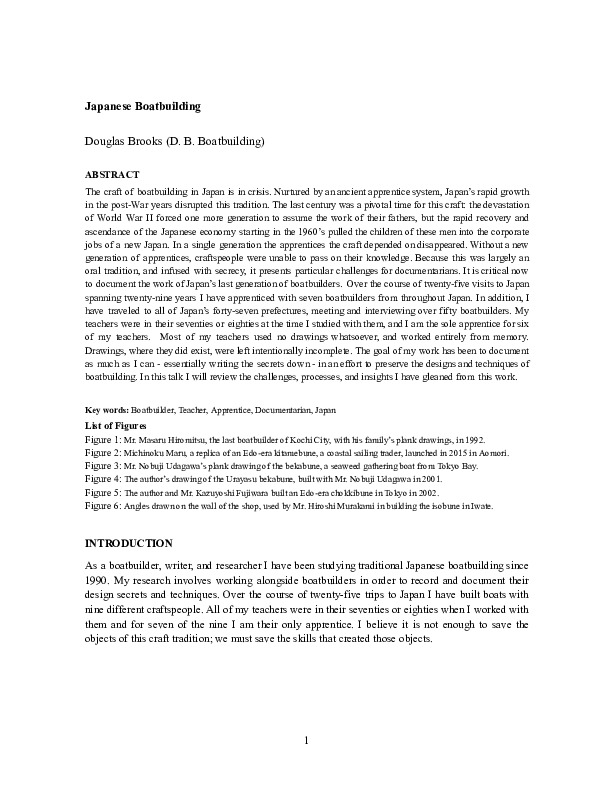
Japanese Boatbuilding
by Douglas Brooks
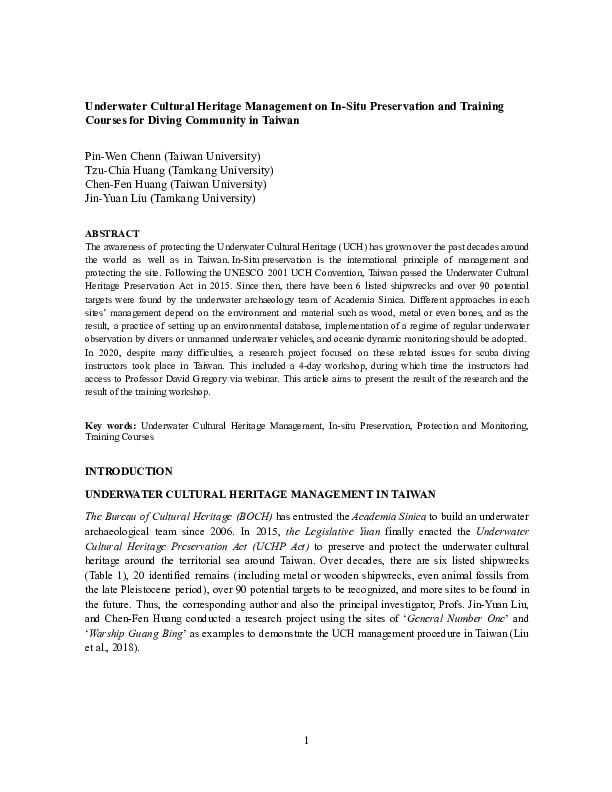
Underwater Cultural Heritage Management on In-Situ Preservation and Training Courses for Diving Community in Taiwan
By Pin-Wen Chenn, Tzu-Chia Huang, Chen-Fen Huang, and Jin-Yuan Liu
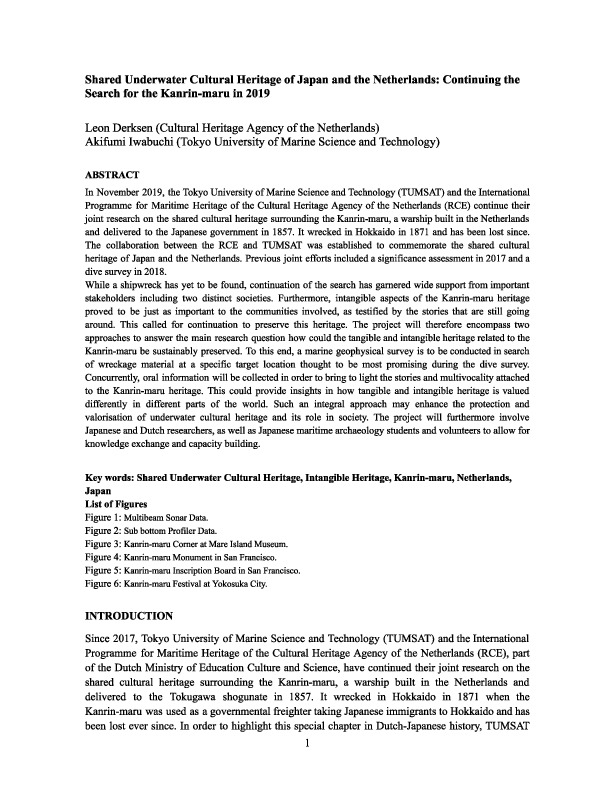
Shared Underwater Cultural Heritage of Japan and the Netherlands: Continuing the Search for the Kanrin-maru in 2019
By Leon Derksen and Akifumi Iwabuchi
Yabitsu: A Midieval Port in Tsushima Island
By Kenzo Hayashida
Lagoon as a port: reconstructing topography and seascape of the past
By Tomo Ishimura
The Submerged Buddhist Temple of Tanjo-ji in Chiba Prefecture, Japan
By Akifumi Iwabuchi, Hayato Kondo, and Takatsugu Tashir
The Importance of Underwater Archaeology in the Development of a Taiwanese Identity - A case study on the Green Island 1
By Sterre Klaver
Maritime Cultural Landscapes and Seascapes in Prehistoric Japan:
The Entangled Sea of the Yayoi Period
By Anja Krieger
The Earliest Hokkien Maritime Vocabulary and Jargon Recorded in a Spanish-Chinese Dictionary of the 17th Century
By Xu Lu
The Port of Uraga: Tokugawa Japan’s Choke Point to Edo
By T. Michael Perrin